

Latest News


RK3588 + ES8388: High-Performance Audio Design
In the field of high-performance embedded development, the Rockchip RK3588 is widely utilized for its exceptional computing power. To achieve high-quality audio interaction, WEATHINK has adopted the highly cost-effective ES8388 codec chip. This article, based on hardware schematics, provides an in-depth analysis of the practical design for headphone output and Line In input within this solution.
1. Solution Overview and Core Advantages
1.1 Hardware Combination
The RK3588 features robust I2S bus resources, while the ES8388 is a low-power codec integrated with a stereo ADC and DAC. Combining these two allows for industrial-grade audio capture and playback at a lower cost.
1.2 Application Scenarios
This audio solution is suitable for smart commercial displays, industrial Human-Machine Interfaces (HMI), edge computing gateways, and high-end consumer electronics, meeting user demands for voice interaction and high-fidelity audio.
2. Core Codec Circuit Design
2.1 Power Supply and Filter Isolation
As shown in schematic 001.jpg, power supply stability is key to audio quality. The system uses a magnetic bead (FB900) to isolate the analog power supply (VCCA3V3_CODEC) from the digital power supply. Combined with multiple sets of 4.7μF and 100nF capacitors, this effectively filters out high-frequency noise, ensuring the noise floor is kept at an extremely low level.
2.2 I2S Signal Transmission
The RK3588 connects to the ES8388 via the I2S0 interface. In the design, 0Ω resistors (R902-R906) are connected in series on the MCLK, SCLK, LRCK, and data lines. This design not only facilitates post-stage signal integrity debugging but also serves for impedance matching in complex electromagnetic environments.
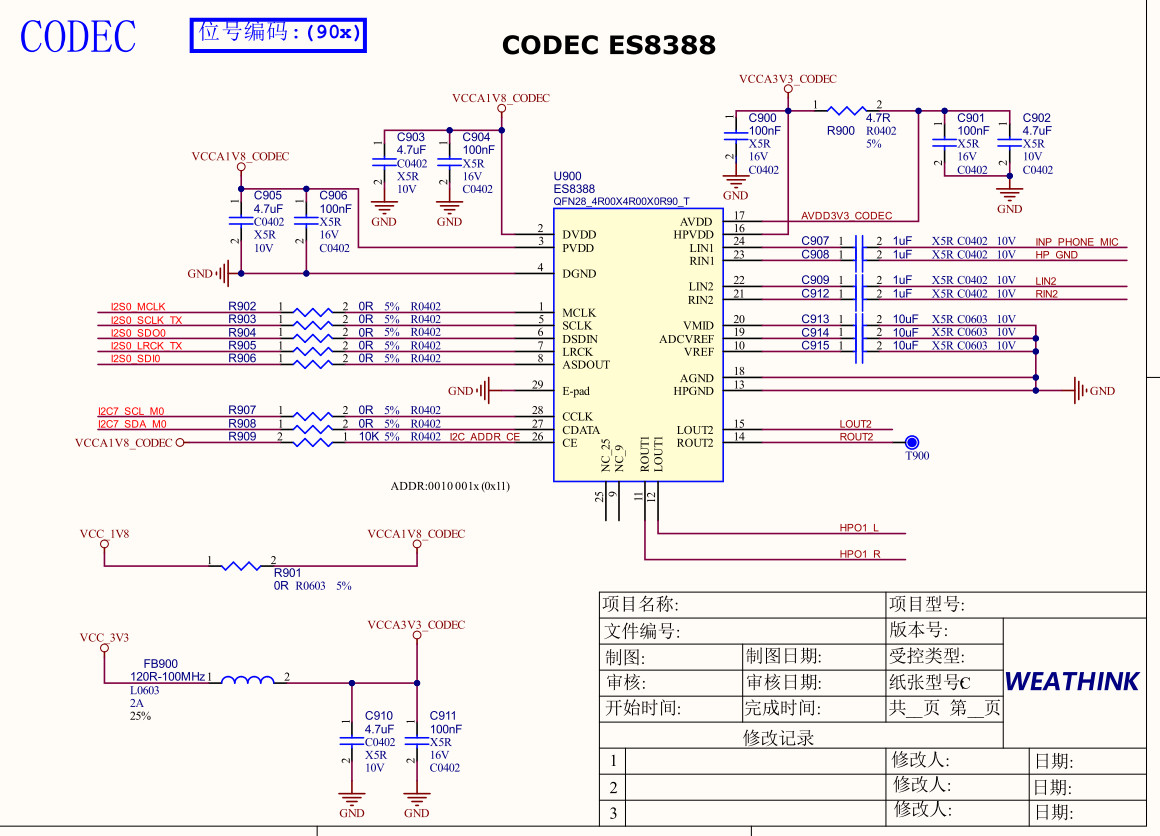
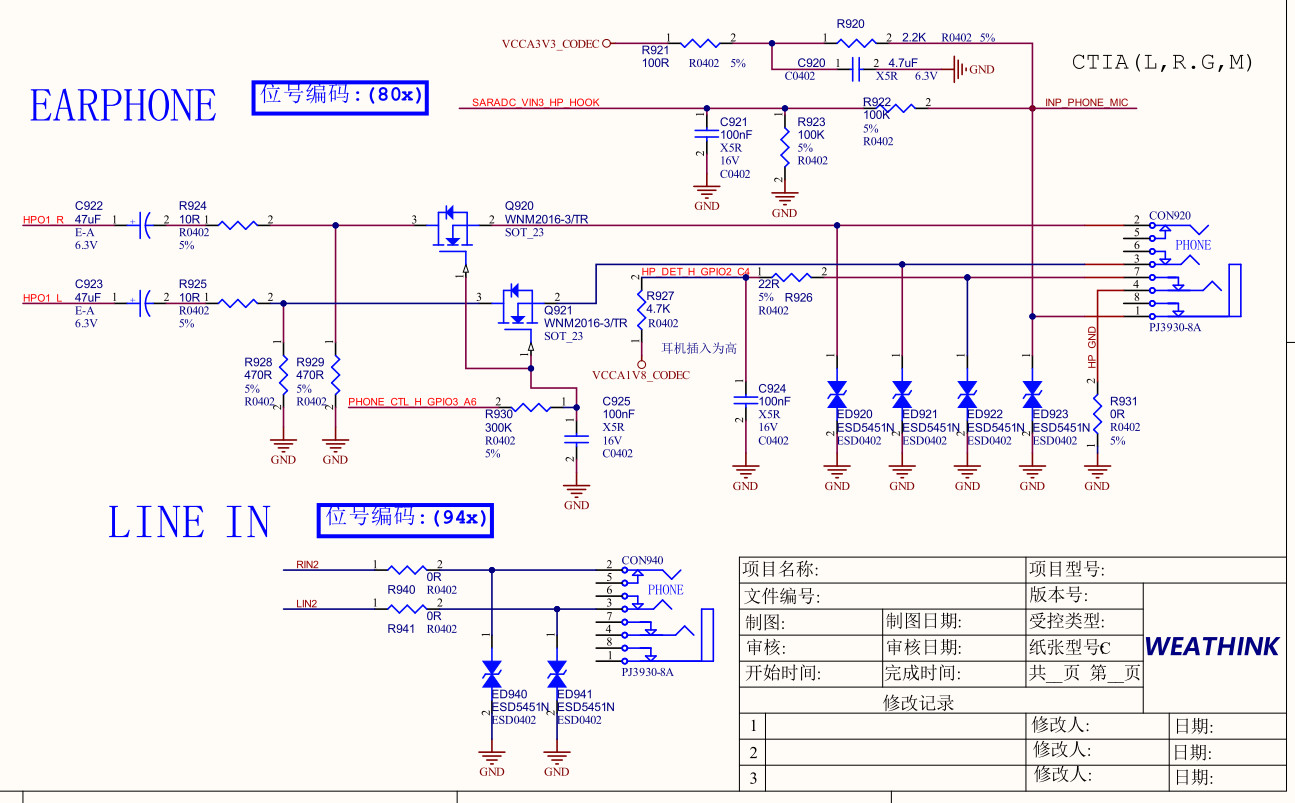
Figure 1 Connection Diagram
3. I/O Interface Circuit Implementation
3.1 Headphone Output Circuit
Referring to schematic 002.jpg, the headphone output uses 47μF electrolytic capacitors (C922/C923) for DC isolation. To solve the "pop" sound issue during power-on/off, WEATHINK designed a mute control circuit based on MOSFETs (Q920/Q921). Additionally, dedicated ESD protection tubes (ED920-ED923) are deployed at the interface to significantly improve anti-static reliability.
3.2 Line Input (LINE IN) Circuit
The LINE IN circuit (RIN2/LIN2) enters the codec through a simple RC coupling circuit and is also equipped with ESD protection devices. This design ensures signal purity when external audio equipment is connected and prevents surge voltage from impacting the core chip.
3.3 Headphone Detection Function
Through the HP_DET_H signal, the system can sense the headphone insertion status in real-time. This hardware design, combined with software drivers, enables automatic switching of the audio output path (e.g., automatically switching from speaker to headphones).
4. Summary and Technical Support
4.1 Key Design Points
To implement the RK3588 with an external ES8388 solution, focus must be placed on the separation of analog and digital grounds, power supply ripple suppression, and ESD protection at the output terminals.
4.2 WEATHINK Services
As a professional embedded solution provider, WEATHINK offers hardware customization and driver debugging support based on the full range of RK3588 platforms. If you encounter issues such as high noise floors or detection failures during audio development, feel free to contact our technical team for deep optimization.
Keywords: RK3588, ES8388, Audio Solution
Description: This article provides an in-depth analysis of WEATHINK's hardware design, detailing how to integrate the ES8388 audio codec on the Rockchip RK3588 platform to achieve stable and reliable headphone output and LINE IN input, complete with schematic references and key design points.